Case Study
Building the Big Board
How we rebuilt the election touchscreen Steve Kornacki uses on live TV. I co-built it and led the design, with Michael Small and NBC News Digital's product and tech teams. About 10 million people watching on NBC and MSNBC. Zero crashes. This is the full story.
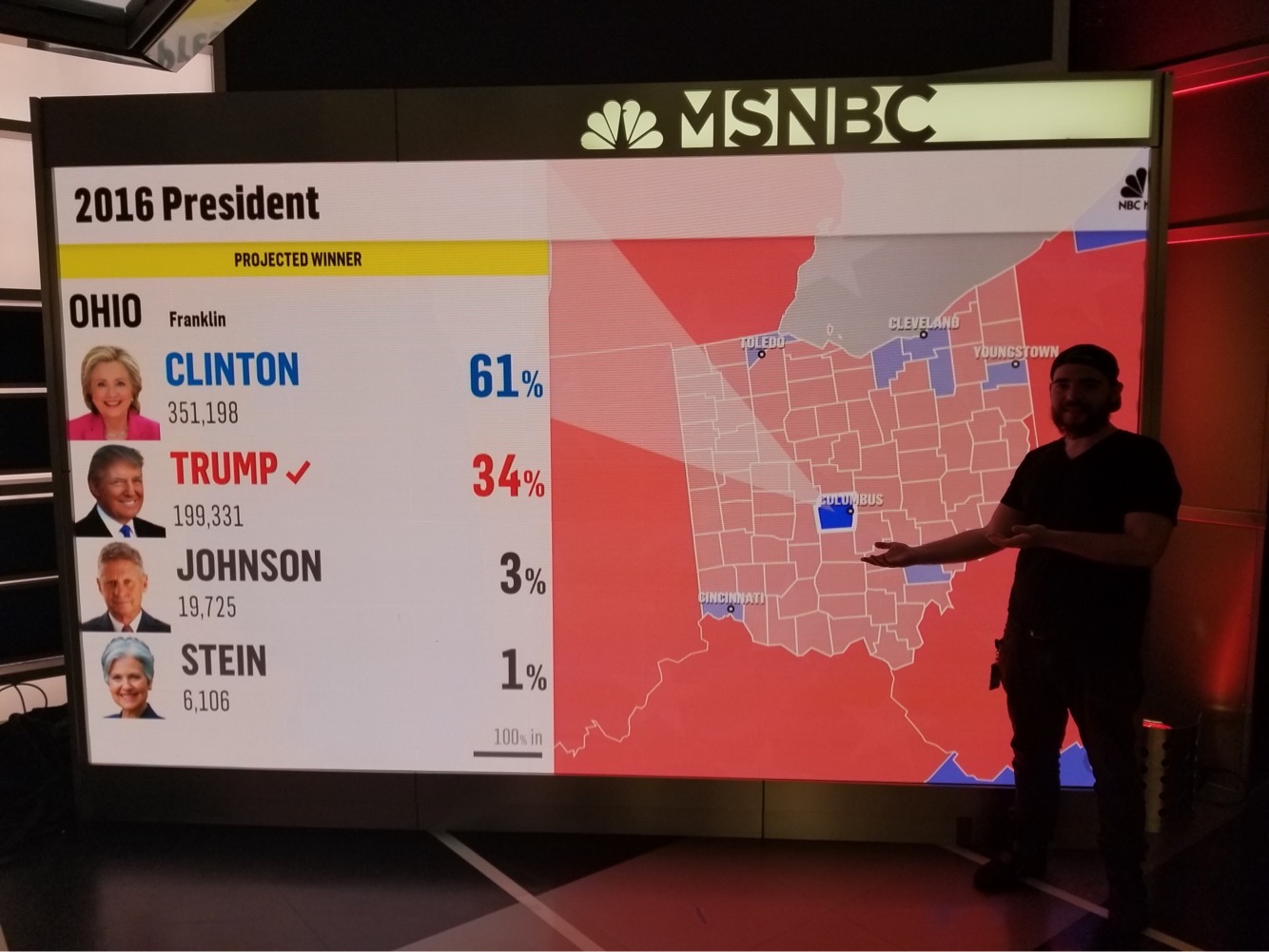
Me with the Big Board at 30 Rock, election night 2018
The Problem
NBC's existing election touchscreen was showing its age. The interface was clunky. The maps couldn't zoom to county level smoothly. And Steve Kornacki—the human phenomenon who turns election data into compelling TV—was fighting the technology instead of flowing with it.
The stakes were absurd. Election night is the Super Bowl of news. Millions of viewers. Live TV. No second takes. If the app crashes, you've just created a viral moment for all the wrong reasons.
The constraint: Build something that feels like magic on a 82-inch touchscreen, handles real-time data from 3,000+ counties, and absolutely cannot fail.
The Approach
I started with a prototype. Not a proposal. Not a requirements doc. A working prototype that showed what was possible.
In January 2018, I demoed it to Steve's producer. Then to Steve himself. Then to the executives. Each demo added momentum. By spring, we had budget and a team.
Technical decisions that mattered
- —D3.js + Vue: D3 for the maps and transitions, Vue for the UI state. This combo let us build complex interactions without fighting the framework.
- —TopoJSON: Compressed geographic data. A 50MB shapefile becomes 2MB. Critical for smooth zoom transitions.
- —Pre-rendered base layers: The map tiles were pre-rendered. Only the data overlays updated in real-time. This separation of concerns saved us.
- —Graceful degradation: Every feature had a fallback. If the live data feed died, we could switch to cached data seamlessly.
What Almost Went Wrong
Around 9 PM on election night, Steve tapped Montana. Nothing happened. He tapped again. Still nothing. The map was frozen on live TV.
My heart stopped. I was watching from the control room, headset on, listening to the chaos.
But here's the thing: the app wasn't frozen. The video feed from the app to the broadcast system had hiccupped. His touch inputs were landing and the app was processing them correctly—the output just wasn't making it to the screen.
The control room re-routed the video feed. 15 seconds later, we were back. Most viewers probably didn't notice.
Lesson: Build systems where you control the failure modes. I couldn't control the broadcast infrastructure, but I could control how the app behaved. It never actually crashed.
The Results
10M
watching on NBC and MSNBC
0
app crashes
"A newly juiced-up model of the board that can zoom in on the most obscure House districts"
— The New York Times
"Kornacki, eli5-ing races with sleeves rolled up and an 82-inch vertical touchscreen... looked amazing with the board, panning and zooming"
— Vulture
Chuck Todd's producer said it was the first election night where Chuck wasn't frustrated with the app. That might be the compliment I'm proudest of.
The Pattern
This project taught me a pattern I've used ever since:
- 1.Start with a working prototype. Not a deck. Not a proposal. Something people can touch and react to.
- 2.Understand the performer. Steve Kornacki has a specific way of thinking and moving. The app had to feel like an extension of his hands, not a barrier.
- 3.Design for the failure mode. What happens when things go wrong? Make that graceful, not catastrophic.
- 4.Ship something real, then iterate. The app that shipped in November was very different from the January prototype. But without that prototype, nothing would have shipped.
More Case Studies
Have a high-stakes project?
I specialize in systems that can't fail when it matters most.
Let's talk